Quasar Discovered From 630 Million Years After Big Bang
Astronomers spot a quasar from 630 million years after the Big Bang, shedding light on early cosmic evolution.
 World News
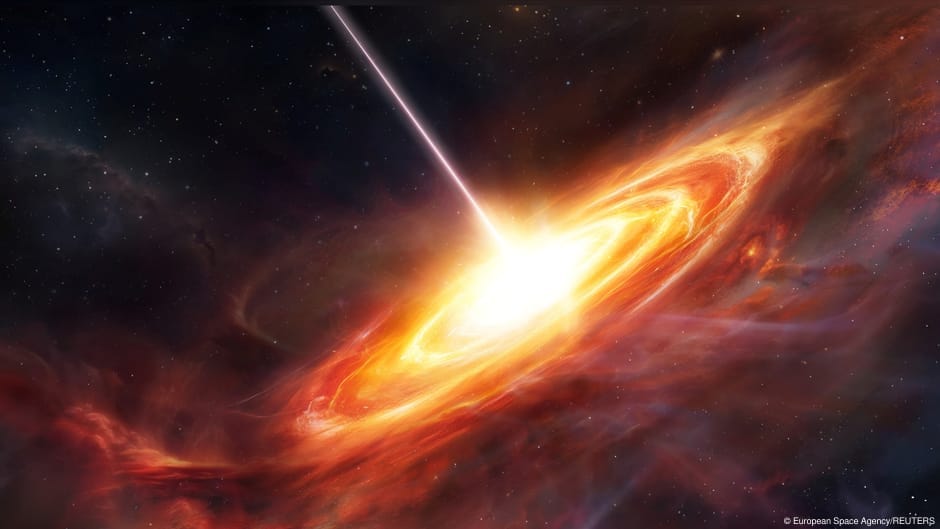
An international team of astronomers has identified a quasar that formed roughly 630 million years after the Big Bang, making it one of the earliest known supermassive black holes.
The object is observed as it existed 13.1 billion years ago, when the universe was less than five percent of its present age, allowing scientists to study conditions in the infant cosmos.
The discovery was made using deep‑space observations that captured the quasar’s light, which has traveled across the expanding universe to reach Earth’s telescopes.
Researchers say the finding provides a rare glimpse into the formation of massive structures shortly after the universe’s birth, challenging existing models of early black‑hole growth.
Further analysis of the quasar’s properties is expected to refine theories about how such massive objects could develop so quickly after the Big Bang.
More in World News
 World News
Thanksgiving Storm Cuts Power to 500,000 Across East Coast
 World News
U.S. Army Conducts Controlled Detonation of Lead Explosives in Iowa
 World News
Seven-Year-Old Rescued After Russian Strike Leaves Nine Dead in Ukraine
 World News
Finnish Forces Tow Russia-Bound Vessel After Drone Attack in Gulf of Finland
 World News
FBI’s Ten‑Most‑Wanted Mexican Drug Lord Arrested After Shoot‑out
 World News